Assessment
KOREA ENTRY ASSESSMENT
How your brand will translate into Korea, written for the decision you are about to make — with every finding marked by how certain we are.
01THE PROBLEM
You already know Korea is an opportunity. That was never the hard part.
- 01
Your distributor says yes to everything.
The people encouraging you to enter rarely carry the cost of entering badly. Enthusiasm is not evidence, and it is the cheapest thing to get.
- 02
The category looks open in a spreadsheet, crowded on a shelf.
Desk research counts competitors. It does not show you what a shopper sees in the few seconds they give your category.
- 03
You were told to localize — but not what to change.
Translation is the part everyone does. Naming, price framing and category language are where brands get quietly misread.
- 04
Every deck sounds equally confident.
When nothing is marked uncertain, you cannot tell a finding from a guess. So the decision ends up resting on tone.
02WHAT YOU GET
A Korea Entry Assessment, and a session to argue with it.
One document, written for the decision you are about to make. We do not email it and disappear; we read it with you, section by section, including the parts we could not answer.
- 01
The decision
Go, test first, or not now — and the first action, before anything is committed.
- 02
First customer, and one line
The one group to win first, and the line to lead with in Korea.
- 03
The shelf and the price ladder
The Korean products you would sit beside, and the prices they sell at.
- 04
Routes into Korea
The ways in, compared, with the one to start with.
- 05
Can it make money?
The most a unit can cost landed, worked back from prices Korean buyers already pay.
- 06
Before the first shipment
Registrations, labels and claims to settle first, item by item.
- 07
Keep, change, test
What the market gives no reason to change, what must change, and what only a test can settle.
- 08
Korea Market Fit
A directional score across six components, with the reasoning behind each one.
- 09
Unknowns, and the next 90 days
The open questions, and the tests that settle them — each with a go and a stop rule.
- 10
One page to keep
Every decision in one line, with every source behind them.
- DELIVERABLE
- Korea Entry Assessment, in English
- FORMAT
- Written assessment + walkthrough session
- TURNAROUND
- One week, from your first message to the walkthrough
- EVIDENCE
- Every finding labelled by certainty
HOW IT RUNS
- 01
You write to us
Someone on the team replies within two business days.
- 02
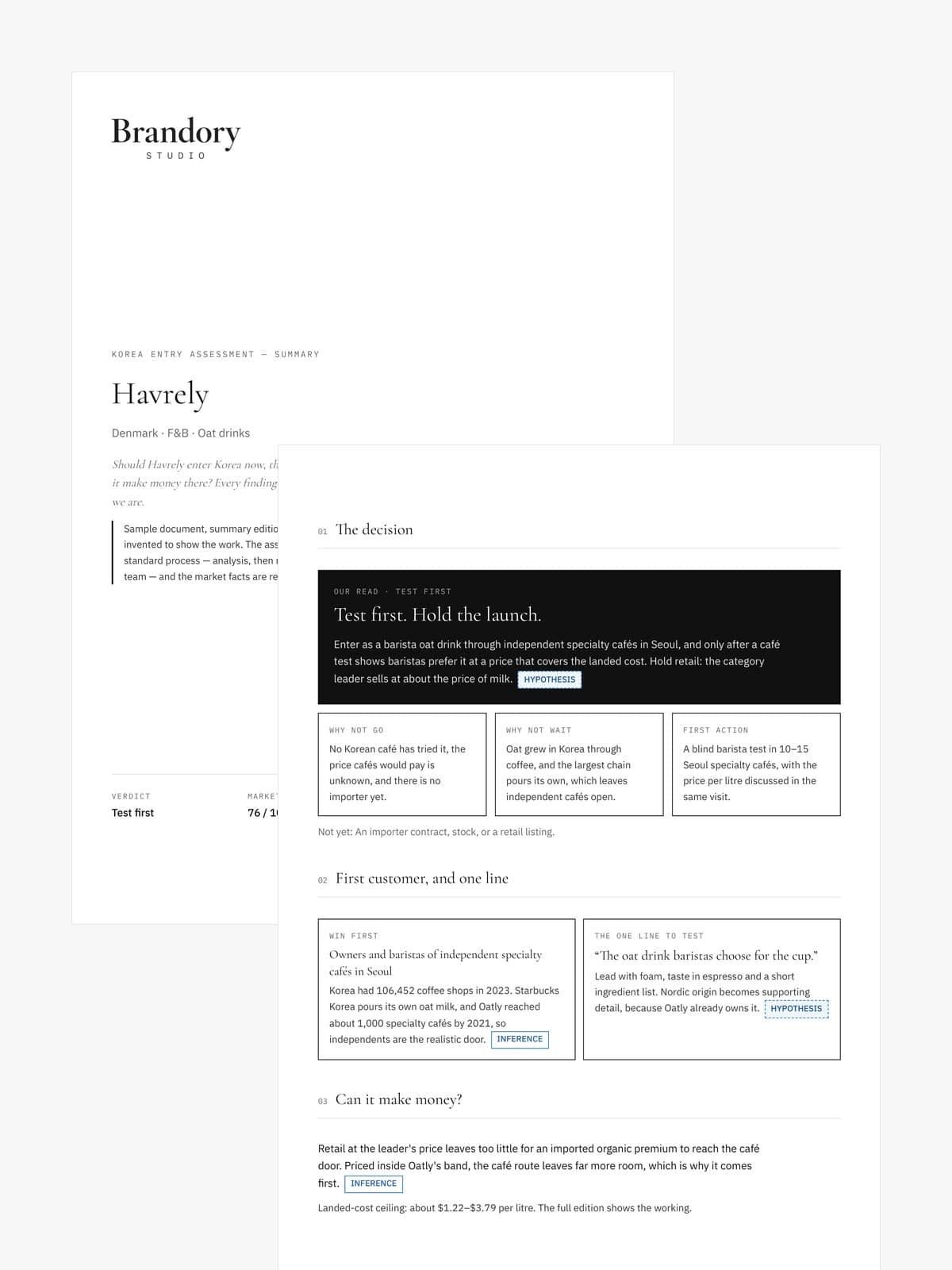
Summary edition
Every inquiry starts with a short read of your brand: the decision, the first customer, the money question and what is still unknown.
- 03
Invoice and start
Once the scope is agreed, we send an invoice. Work starts when the 50% deposit arrives.
PAY AN INVOICE → - 04
Full assessment
The ten sections above, written for your decision, with every source attached.
- 05
Walkthrough
We read it with you, section by section, including the parts we could not answer.
03HOW WE WORK
Most market research tells you what to do. We tell you what we know.
Starts with a recommendation.
Starts with what can be verified.
One level of confidence for every claim on the page.
Four, marked on every statement — confirmed, inferred, hypothesis, unknown.
A general Korea market report.
Our own Korean market library, cited line by line.
Findings that would fit any brand in the category.
A finding that would fit another brand has failed.
A deck at the end.
A document you can argue with, section by section.
Three steps, in this order.
- 01
Diagnose
Read the brand as it is, and the question it arrives with. Nothing is proposed yet.
- 02
Assess
Weigh it against our Korean market library. Every finding is labelled confirmed, inferred, hypothesis or unknown.
- 03
Validate
Set out what to test first, in order, before anything is spent — and read the document through with you.
04RESEARCH PRINCIPLE
What we know,what we infer,what we would test,and what we don’t.
Brandory separates information into four categories — so that a directional insight is never mistaken for a confirmed fact.
- CONFIRMED
- Information directly provided or publicly available.
- INFERENCE
- Reasonable interpretation based on available information.
- HYPOTHESIS
- Potential explanations or opportunities that require validation.
- UNKNOWN
- Questions that cannot be answered with the currently available information.

A market is not a checkbox.
05FOCUS INDUSTRIES
Consumer brands. Different contexts.
Food & Beverage
Packaged goods, dining, beverage brands
SEE WORK→Taste expectations, labeling norms, and distribution partners require early validation.
Living & Lifestyle
Home, tableware, fragrance, everyday goods
SEE WORK→Price positioning and everyday-use context often diverge from the brand's home market.
Beauty & Personal Care
Skincare, cosmetics, body care
SEE WORK→One of the most saturated categories in the market, where differentiation is rarely obvious.
Fashion
Apparel, footwear, accessories
SEE WORK→Category perception, sizing conventions, and channel mix shift sharply across markets.
06QUESTIONS
Questions, answered plainly.
About the assessment
What is a Korea Entry Assessment?
A written assessment, in English, of how your brand would land in Korea before you spend on distributors, stock or campaigns. It gives a decision (go, test first, or not now), the first customer to win, the routes into Korea, what the product can cost to land and still sell, what must be done before the first shipment, and what is still unknown. If the answer is "not now", it says so, with the reasons and what would need to change. We then read it with you in a walkthrough session.
Who is it for?
Growth-stage, founder-led consumer brands that already sell beyond their home market and are considering Korea. Our focus is Food & Beverage and Living & Lifestyle; we also assess Beauty & Personal Care and Fashion.
How long does it take?
One week, from your first message to the walkthrough. We reply to every inquiry within two business days.
How much does it cost?
We quote after a short conversation, because the scope depends on your category and how far the work needs to go. We do not publish prices.
What do the labels CONFIRMED, INFERENCE, HYPOTHESIS and UNKNOWN mean?
Every finding says how certain it is. CONFIRMED is backed by a source we cite. INFERENCE is reasoned from cited sources. HYPOTHESIS is our view, to be tested. UNKNOWN means we could not find reliable evidence, and we say so rather than guess.
Where does your Korean market evidence come from?
From a library of Korean market documents our team writes and checks: regulations, tariffs, channels, prices and consumer data, each with its source and the date it was verified. A price that does not appear in a cited source is removed from the assessment.
What is not included?
We do not handle registration, labelling or customs, and we do not sign or negotiate agreements on your behalf. Where the assessment covers rules, it says what applies and where to confirm it; a licensed customs broker or regulatory specialist should confirm before you act. The assessment names the routes into Korea and what each one requires.
Is the information I share kept confidential?
Yes. We do not share your information with third parties, and we do not name you as a client without your written permission.
Are the brands on your Work page clients?
No. They are concept studies of fictional brands, run through the same process to show how an assessment reads. Each one is labelled as a concept study.
How is this different from a government trade office or a consultancy?
Government trade offices serve companies from their own country and focus on market information and introductions. Consultancies vary widely in scope, from marketing to localisation. What we add is a decision: a written go, test first or not now within a week, with every finding labelled by how certain it is, and a session where we go through it with you.
Selling in Korea
Do I need a Korean importer to sell food in Korea?
In practice, yes. Food imported for sale must be brought in by a business registered with Korea's Ministry of Food and Drug Safety (MFDS) to import and sell imported food. The factory that makes the product must be registered as a foreign manufacturing facility before the first import declaration, and every shipment is declared and inspected before it clears customs. Most foreign brands work with a Korean importer that already holds this registration. (As of 2026.)
Does imported food need Korean labels?
Yes. The import declaration has to include the packaging with the Korean label (a Korean sticker on the existing packaging counts) or a document showing the Korean label content, plus a colour photo of the product that shows its Korean and country-of-origin labelling, so the label must be ready before the goods ship. The country of origin may be shown in English, such as "Made in France". Many brands start with a Korean label applied to their existing packaging; confirm the current labelling rules for your product type before you print. (As of 2026.)
Does tableware need approval before it can be sold in Korea?
Plates, bowls, cups and anything else that touches food count as food-contact articles, and they must be declared to the MFDS on import, as food is. The MFDS has warned about products that cleared customs without this declaration and were then found on sale. Glazed ceramics are tested for lead and cadmium release, so test colour-glazed pieces before planning a launch. (MFDS guidance, as of 2026.)
Do homeware and furniture need KC certification?
Many products do. Korea's KC product-safety system has three levels, set by risk: safety certification, safety confirmation and the supplier's declaration of conformity. Each applies per model and must be completed by the manufacturer or importer before customs clearance or release. Examples include pressure cookers (certification), flooring and digital door locks (confirmation), and chests of drawers 762 mm or taller and window blinds (supplier's declaration). Products that use electricity, such as lamps or electric diffusers, fall under separate electrical safety rules. (Korean Agency for Technology and Standards, as of 2026.)
Can I sell to Korean customers from my own website?
Yes, as cross-border sales. A Korean consumer can buy goods for personal use without an import declaration up to US$150, or US$200 for goods shipped from the US; health supplements, alcohol and functional cosmetics are among the exceptions. Korean consumer law gives online buyers 7 days to cancel a purchase, so check how your returns policy applies to Korean orders. Cross-border sales can show demand, but selling through Korean retailers still needs an importer. (Duty-free limits as of 2024; consumer rules as of 2026.)
NEXT ENTRY
If Korea is your next market, start with what can be known.